Template
Plumbing quote template (free, Canada)
A free plumbing quote template for Canadian plumbers: a spreadsheet and calculator for call-out, labour, parts, permits, margin and GST/HST.
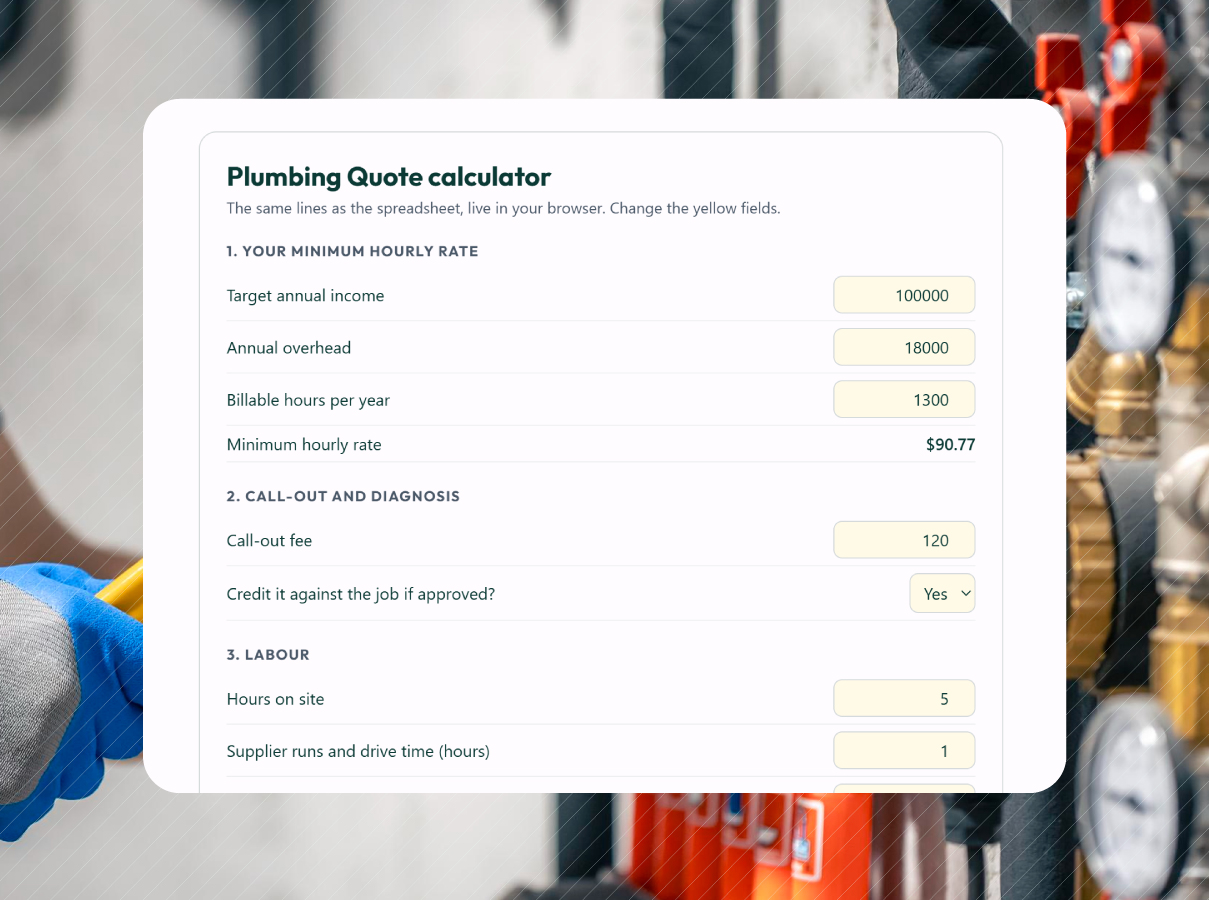
A free plumbing quote template that works out your floor price before you send a number: call-out, labour, parts, permits, overhead, margin and GST/HST. Use the spreadsheet job after job, or run the calculator on this page from the van.
What the template works out
Fill in the yellow cells. Everything else calculates.
- Your minimum hourly rate. Target income plus yearly overhead (van, tools, insurance, licence), divided by the hours you can actually bill.
- Call-out and diagnosis. The fee for the first visit, and whether it comes off the price when the customer goes ahead.
- Labour. Hours on site, supplier runs and drive time, and the inspection visit.
- Parts and fixtures. Quantity, unit cost and who supplies each item. Customer-supplied parts count as zero: you install them, you do not mark them up.
- Permits, access and disposal. The permit fee passed through at cost, opening and patching walls or ceilings, and removing the old fixture.
- Overhead. This job’s share of your yearly running costs, as a percentage of labour.
- Contingency. A buffer for what you find once the work is open.
- Profit margin. Added on top. The result is your floor price before tax. Below it, you are working for free.
- Tax and payment. GST/HST, the deposit, and the balance after the call-out credit.
Both versions are filled in with an example, a 50-gallon electric water heater swap, so the format is clear before you overwrite it with your own numbers.
What to put on the quote you send
The spreadsheet is for you. The quote the customer sees needs these lines, because each one protects your margin.
Scope, including what is not included. “Replace the vanity” can mean the faucet, the drain, the shut-offs, or the countertop too. Write down what you are doing and what you are not. If it is not on the quote, it is an extra.
The call-out fee. Put it on the quote and say whether it comes off the price when the customer goes ahead.
Who supplies the fixtures. Customers often buy their own toilet or faucet online. Say so, and say that you do not warranty parts you did not supply. If the part is wrong or damaged, the extra trip is billable.
Access and making good. If you open a wall or a ceiling, say whether you close it, patch it rough, or leave it for the drywaller. This line prevents the most arguments after the job.
An extras clause for hidden conditions. Old galvanized lines, a corroded stack, a seized shut-off. One line protects the margin: “Conditions found once the work is open will be quoted and approved before we continue.”
Permit and inspection. Show the fee as its own line so the customer sees it is not your markup.
Water-off time. Tell the customer how long the house is without water. It stops the call two hours in.
Warranty. What you cover on your workmanship and for how long.
Validity, deposit and GST/HST. How long the price holds, the deposit to book the date, and GST/HST on its own line with your registration number.
Common mistakes on plumbing quotes
- Giving the price over the phone. A number said before you see the job becomes the price. Quote the call-out, then send a written quote after the visit.
- Parts at cost. Sourcing, the supplier run and the returns counter are office work. The template adds a parts margin for this. The markup and margin calculator shows what that margin really is.
- No line for access. Opening and closing a ceiling can take longer than the repair. If it is not priced, you do it for free.
- Forgetting drive time and the second trip. A missing fitting means another run to the supplier. The template has its own line for it.
- Quoting gas work on the same line. Gas work has its own licensing and permits in every province. Quote it separately, and only if you hold the certificate.
Flat price or hourly?
Most homeowners want a fixed price for planned work like a fixture swap or a water heater. Emergency calls and diagnosis are usually billed by the hour, because nobody knows what is behind the wall yet. Either way, start from what an hour of your time really costs. The contractor hourly rate calculator works it out from your costs, your unpaid office hours and the income you want.
Let your office do this
Pricing in the van between calls is office work. In Duuabl you take photos on the visit, add a few notes or a voice memo, and the quote is built for you with your prices, your terms and GST/HST. The customer approves it on their phone, pays the deposit, and the job is on your schedule. If something turns up once the wall is open, the extra goes to the customer for approval before you carry on.
FAQ
Should I charge for the first visit?
A call-out fee covers your drive and diagnosis time. Many plumbers credit it against the job if the customer goes ahead. The template handles both: switch the credit to Yes or No.
Do I need a permit for this job?
It depends on the work and the municipality. Replacing a fixture like for like often does not; adding or moving lines, or installing a water heater, often does. Check with the local building department before you quote.
How much deposit should a plumber ask for?
Enough to cover special-order parts and fixtures and to hold the date. Check your province’s rules for home renovation contracts before you set it.
Do I need to charge GST/HST?
Once you are registered, yes. The CRA explains when registration is required for small businesses.
Keep reading.
More templates and straight answers from people who ran the office.
 Calculator
Contractor overhead calculator
Add your fixed monthly costs to the value of the hours you spend on office work, then divide…
Read it
Calculator
Contractor hourly rate calculator
Add the income you want to your yearly business costs, divide by the hours you can really bill…
Read it
Calculator
Job profit calculator
Take the price plus any extras you billed, subtract the hours the job really took and the materials…
Read it
Calculator
Markup and margin calculator
Markup is profit divided by cost. Margin is profit divided by price. A 25% markup is only a…
Read it
Calculator
Painting cost calculator
Work out the wall area from the floor area and ceiling height, take off doors and windows, multiply…
Read it
 Guide
How to price a renovation job without losing money on it
A pricing framework for renovation and construction contractors - labour, materials, overhead, and margin. Know your floor before…
Read it
 Template
Renovation quote template
A free renovation and construction quote template, the same six-line pricing framework contractors use to know their floor…
Read it
 Industry Insights
The Data Problem in Construction Is Not at the Top. It Is at the Bottom.
Everyone points to enterprise construction when they talk about the data gap. The real gap is one layer…
Read it